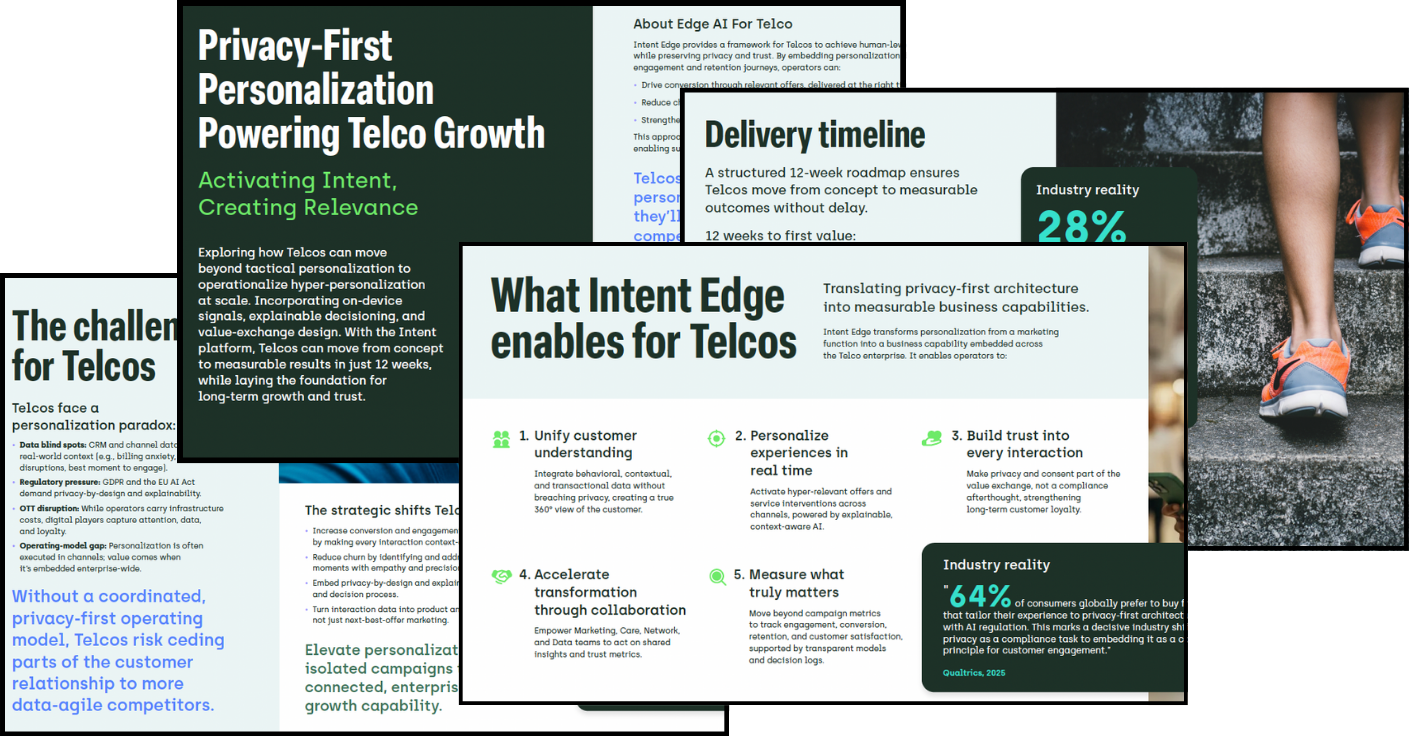
Why Telco Personalization Is Broken And How Privacy Fixes It
Telcos believe personalization is about relevance. Customers believe it’s about respect.
That gap is where churn begins.
For years, personalization in telecom was treated as a campaign optimization problem: better segments, smarter offers, more data. It worked, until customer expectations and regulation changed the rules.
Today, Telcos face rising churn, fragmented journeys, tightening regulation, and OTT players owning the experience layer. In that reality, traditional personalization models are no longer just ineffective, they’re risky.
The personalization paradox Telcos can’t ignore
Telcos have more data than almost any industry. Yet most personalization still relies on static CRM attributes and after-the-fact logic.
The result? Mistimed offers. Broken moments. Lost trust.
A device upgrade during a network outage. A sales push in the middle of billing anxiety.
These aren’t marketing failures. They’re context failures.
Why “more data” is now the wrong answer
Regulation has made one thing clear: personalization built on opaque, centralized data models won’t survive.
GDPR and the EU AI Act demand privacy-by-design, explainability, and accountability. Retrofitting compliance onto legacy personalization stacks is no longer enough.
Leading Telcos are reaching the same conclusion:
Personalization must be built with privacy, not constrained by it.
From campaigns to an operating model
The real shift isn’t technological, it’s organizational.
For years, personalization has lived inside campaigns, channels, and tools. But value is created when it’s embedded across the enterprise.
Privacy-first personalization works when it becomes an operating model, connecting marketing, care, network, data, and legal teams around real customer moments.
Not who the customer is.
What the customer is experiencing, right now.
Why Edge AI changes the equation
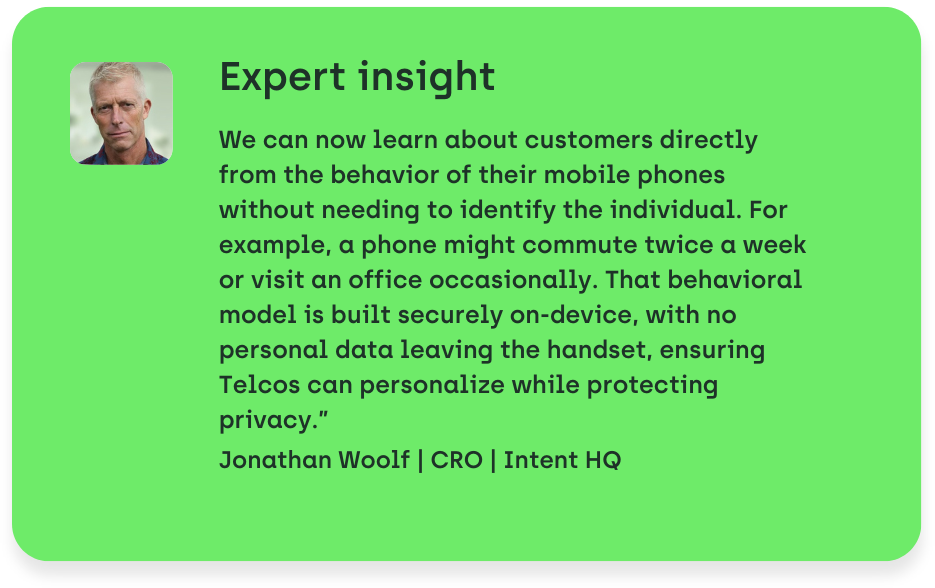
With on-device intelligence, behavioral insight is generated directly on the handset:
No raw personal data leaves the device. Context is captured in real time. Consent and transparency are embedded by design. This enables Telcos to recognize intent as it emerges—low-data pre-switch moments, SIM-switching behavior, network frustration—and respond with empathy, not sales pressure.
This is the approach Intent HQ is enabling with Edge AI, embedding privacy directly into personalization, not layering it on after the fact.
Intent HQ announces a strategic partnership with UKAI to advance responsible, privacy-first AI adoption, combining on-device intelligence with ethical AI frameworks for enterprise use.
Consumers want a personal relationship with their brands. But they also don’t want to feel as though they’re being spied on or having their personal details used inappropriately by marketers.
“The objective of the Intent HQ Chair in Changing Consumer Behaviour is to advance the knowledge about consumers through best-in-class models and processes based on digitally-acquired mass data, while creating an unparalleled test bench where we will be able to test quantitatively different customer models in real-world-environments.” said Prof. Nueno
Utter the words ‘data breach’, and the news spreads just as fast as any 5G network. Over the past 10 years, there have been 300 data breaches involving the theft of 100,000 or more records according to Forbes. And per the World Economic Forum, as of 2019, cyber-attacks are considered among the top five risks to global stability. Sadly, this news isn’t new. But considering that most of the individuals affected by the T-Mobile breach weren’t even existing customers, the headline doesn’t evoke much confidence.
Marketing campaigns are won and lost on the accessibility and quality of the data companies have about their customers. On paper, telecom operators have a huge advantage in this area because no sector holds the same volume or variety of customer data. But are these firms really making the most of this?