
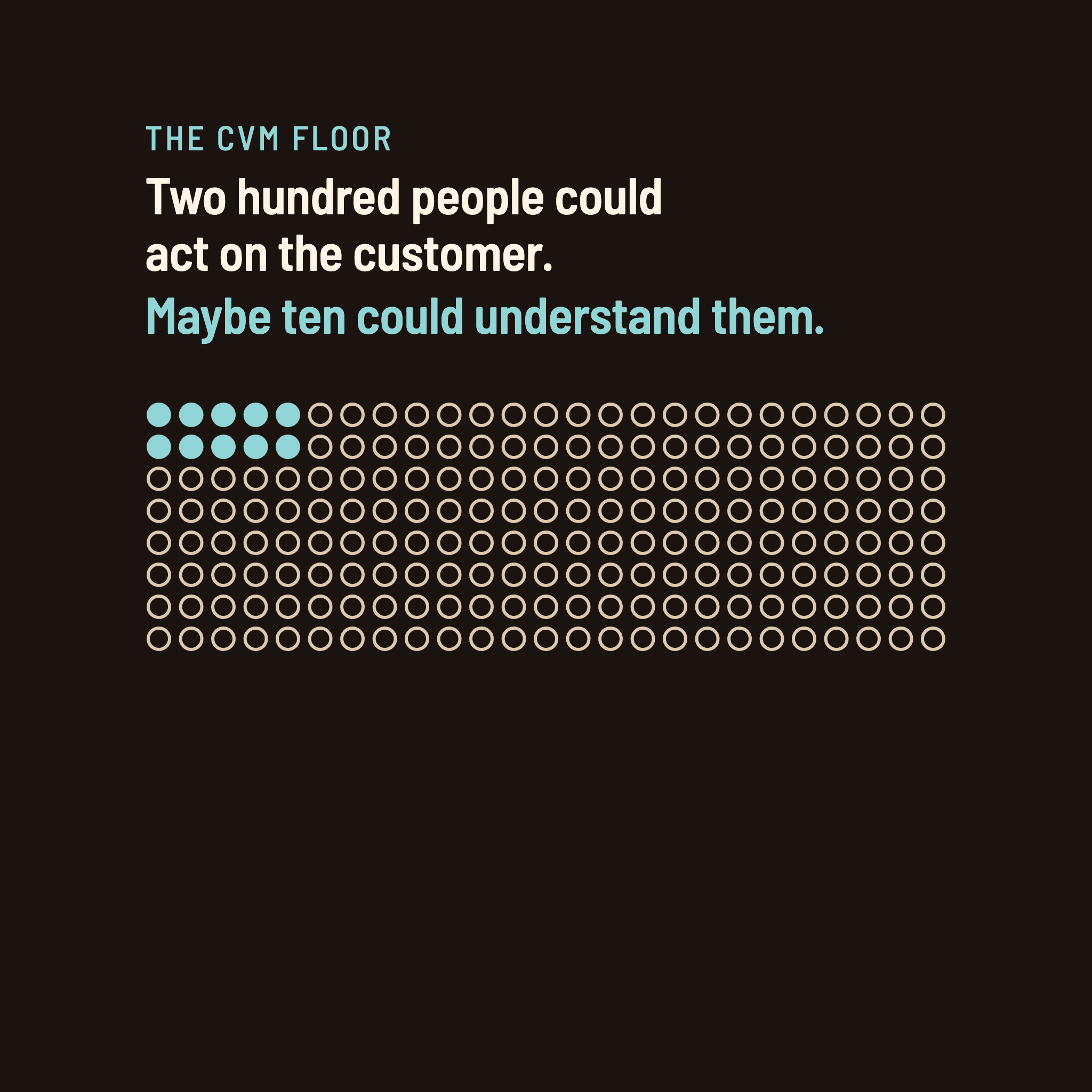
My first internship was on the CVM floor of a Malaysian telco. I was nineteen. Around two hundred people sat in that room, building campaigns to squeeze a little more revenue out of the customer base.
Data bundles. Roaming packs. Recharge bonuses. Win-backs. The work was relentless, and most of it ran on instinct.
A campaign usually started with a hunch. Someone senior felt prepaid users in a region were drifting, or that a festive bundle would sell. If you wanted evidence, you joined the queue for the insights team: a handful of analysts serving the whole floor. By the time the numbers came back, the moment had often passed, and the campaign went out anyway. Then it took weeks of spreadsheets, extracts and sign-offs to get it live across SMS, USSD and the app.
I remember thinking two things. First, that this was painful for everyone involved, including the customer. Second, that a machine should be doing most of it. It took me fifteen years to come back and work on that problem properly. This is what I think was actually broken.
Four things were broken
- Decisions ran on instinct.The data existed. It just never reached the decision in time. Campaigns were chosen in meetings and justified with numbers afterwards. The most confident idea in the room usually won.
- Intelligence was a bottleneck.Understanding the customer lived with a small central team, and every question went through them. Their backlog set the pace for the entire floor. Two hundred people could act on the customer. Maybe ten could understand them.
- Insight stayed locked up.When analysis did get done, it lived in a deck sent to a few senior people. The campaign manager who needed it most rarely saw it, and could never ask it a follow-up question. So the same questions got answered again and again, slightly differently each time.
- Orchestration was too complex.Launching a campaign meant segment extracts, channel requests, eligibility rules, suppression lists and approvals, each owned by a different team. The effort was so high that people stopped experimenting and repeated whatever had launched last time.
These four feed each other. Slow intelligence pushes decisions back to instinct. Locked-up insight means nobody learns from what ran. Complex orchestration means even a good decision arrives late.
- Decisions ran on instinct.
- Orchestration was too complex, so even a good decision arrives late.
- Insight stayed locked up, so nobody learns from what ran.
- Intelligence was a bottleneck, and slow intelligence pushes decisions back to instinct.
What doesn’t fix it
More analysts make the queue a little shorter and leave intelligence just as centralised. More dashboards give the floor more numbers and no clearer idea of what to do with them. A new campaign tool automates the launch steps and leaves the decision exactly where it was: in the meeting, on instinct.
Each of these patches one of the four problems and leaves the other three intact.
What does
Go back to that room and look at it from the customer’s side.
Take a prepaid customer I’ll call Aisyah. She’s just started a new job across town. Her data use has jumped on weekday mornings because she streams on the bus. Her balance runs out faster than it used to, and within a fortnight she’ll probably either buy a bigger bundle or move to a competitor who offers one.
Ten years ago, nobody on the floor would have known any of that. To us, she was a row in a prepaid segment: average spend, average tenure. She got the same festive offer as everyone else in her row.
She was never average. None of them were.
That’s the gap that matters most. The floor knew what customers had done last month. What it needed was a read on what each person was likely to do next, early enough to be useful to them.
That’s what IntentOne is built for. It reads behaviour as it happens, including on the phone itself, and turns it into a prediction about a real person. She’s about to outgrow her bundle. He’s planning a trip. This one is quietly drifting away. Those predictions become opportunities, ranked by what they’re worth and how confident we are, and they go straight to the campaign manager. No ticket, no queue, no deck sent to someone more senior. The person running the campaign can see who, why, and what’s likely to happen if we do nothing.
- A row in a prepaid segment: average spend, average tenure, and the same festive offer as everyone else in her row.
- A prediction about a real person: Aisyah has a new job across town, streams on the bus, and her balance runs out faster.
- Within a fortnight, she’s about to outgrow her bundle.
Acting on it then has to be easy, because a good opportunity that takes three weeks to launch is a missed one. Getting from opportunity to live campaign is a short step in IntentOne, with consent and policy already built in. Every result is measured against similar customers who didn’t get the offer, so the next prediction is sharper than the last.
That’s what I wish that room had had: fewer hunches, and a clear view of the person on the other end.
Same room, different work
At nineteen, I thought automation would mean fewer people in that room. I see it differently now. Those two hundred people were capable. They were starved of intelligence and buried in process.
Give them the intelligence directly, strip out the process, and the same room does very different work.